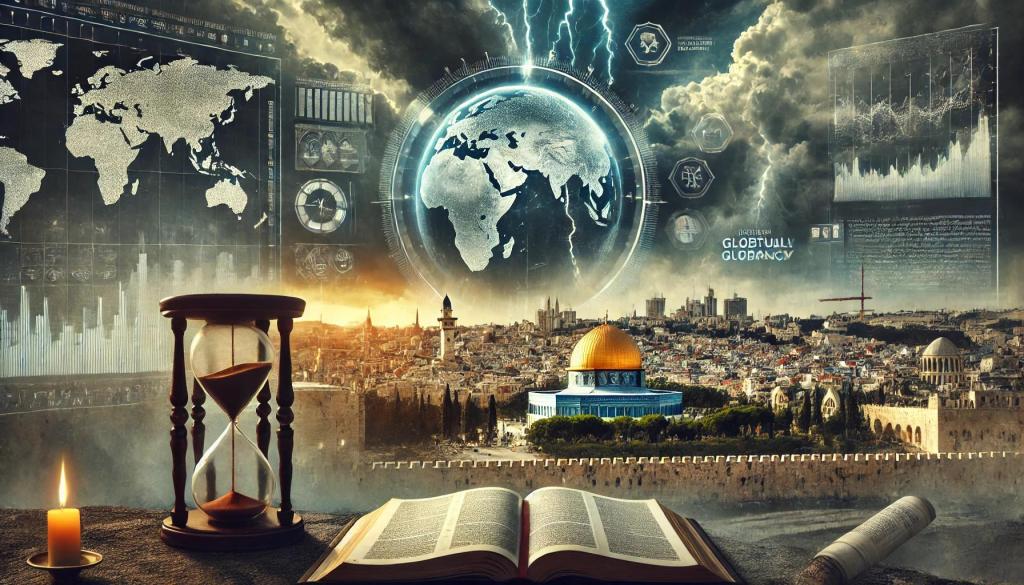
Are Current Events Lining Up with Biblical Prophecy?
For centuries, Christians have looked to the Bible not just as a spiritual guide, but also as a prophetic roadmap. Prophecy enthusiasts and biblical scholars have long analyzed world events through the lens of Scripture, seeking signs that suggest the fulfillment of ancient prophecies. Today, a variety of current events—from geopolitical shifts to natural phenomena—are being interpreted by some as indicators that biblical prophecy is coming to fruition. But what are these events, and how do they align with the predictions found in the Bible?
1. The Rise of Global Instability
One of the key themes in biblical prophecy, particularly in the New Testament, is a period of heightened conflict and unrest in the world preceding Christ’s return. In Matthew 24, Jesus warns of “wars and rumors of wars,” famines, and earthquakes in various places. Some see today’s turbulent geopolitical climate, marked by the ongoing Russia-Ukraine conflict, escalating tensions between the United States and China, and the instability in the Middle East, as evidence of this. The rise of civil unrest, protests, and societal division worldwide can also be seen as a reflection of Jesus’s prediction that “nation will rise against nation, and kingdom against kingdom.”
2. The Middle East as a Fulcrum of Prophecy
The Middle East has always been a focal point for prophecy watchers, particularly Israel. In the Old Testament, the prophet Zechariah speaks of a time when all nations will gather against Jerusalem (Zechariah 12:3). This has led some to view the ongoing tensions between Israel and its neighboring countries, coupled with renewed calls for a Palestinian state, as a fulfillment of these prophecies. The recent Abraham Accords, which sought to normalize relations between Israel and several Arab nations, has sparked discussions about the potential for a broader Middle East peace treaty, reminiscent of the “covenant with many” mentioned in Daniel 9:27—a key event that some interpret as heralding the start of the end times.
3. The Rebuilding of the Third Temple
One of the most anticipated prophetic events is the rebuilding of the Jewish Temple in Jerusalem. According to several biblical passages, the existence of a Third Temple is central to end-times prophecy. For instance, Daniel 9:27 speaks of a future figure—the “Antichrist”—who will desecrate the Temple in what is often referred to as the “abomination of desolation.” Similarly, 2 Thessalonians 2:4 describes the “man of lawlessness” taking his seat in the Temple of God. While there is currently no physical Temple on the Temple Mount in Jerusalem, recent efforts by the Temple Institute and other religious groups to prepare for the reconstruction of the Temple—including creating ceremonial vessels and priestly garments—have caught the attention of prophecy watchers. Some believe that a significant political shift in the region could pave the way for the Temple’s construction, potentially aligning with these biblical predictions.
4. Increase in Natural Disasters
The Bible often refers to natural disasters as signs of God’s judgment and as precursors to the end times. In Matthew 24:7-8, Jesus mentions earthquakes, famines, and pestilences as the “beginning of birth pains” that will precede His return. Many see the recent surge in extreme weather events—ranging from devastating earthquakes and wildfires to record-breaking hurricanes and floods—as fitting this description. In addition, the COVID-19 pandemic and the subsequent global health crises have heightened speculation that the “pestilences” Jesus spoke of are already here, with many viewing these occurrences as a wake-up call for humanity.
5. Moral Decline and Apostasy
Paul’s warning in 2 Timothy 3:1-5 that “in the last days perilous times will come” is marked by a significant moral decline and societal breakdown. He lists characteristics such as people being “lovers of themselves, lovers of money, boastful, proud, abusive, disobedient to their parents, ungrateful, unholy, without love, unforgiving, slanderous, without self-control, brutal, not lovers of the good.” Many Christians point to the increasing prevalence of secularism, the decline of traditional values, and the rise of radical ideologies that redefine gender, family, and morality as evidence that society is becoming what Paul foresaw.
The rise in persecution against Christians around the world, particularly in countries where faith is criminalized, is also seen as a fulfillment of Jesus’s words in Matthew 24:9, where He says, “Then you will be handed over to be persecuted and put to death, and you will be hated by all nations because of Me.” This has led many to believe that the Church is experiencing the beginnings of what the Bible refers to as a great falling away, or apostasy, as mentioned in 2 Thessalonians 2:3.
6. Technological Advancements and the Mark of the Beast
Revelation 13:16-17 speaks of a future time when a global leader, often referred to as the Antichrist, will require everyone to receive a mark on their right hand or forehead in order to buy or sell. This so-called “mark of the beast” has long been a topic of intense speculation. With the rapid advancements in technology—such as biometric systems, digital IDs, and the growing trend toward a cashless society—some argue that the infrastructure for this prophecy is already being laid. Microchip implants, facial recognition technology, and even discussions about digital currencies have prompted concerns that we may be moving toward the system described in Revelation.
While many of these developments can be seen as neutral or beneficial, some prophecy enthusiasts believe that they could be precursors to a future system of global control, aligning with the Bible’s description of a time when “no one can buy or sell unless they have the mark.”
7. A One-World Government and Economic System
The Book of Revelation (Revelation 13 and 17) describes a future scenario in which a powerful global leader arises, exerting control over all nations and uniting them under a one-world government and economy. Recent discussions around global governance, especially in light of major international organizations like the United Nations and the World Economic Forum, have sparked speculation that the world is moving toward a centralized system of power. Global crises such as the COVID-19 pandemic, climate change, and economic instability have led to increased calls for international cooperation, potentially laying the groundwork for a future scenario that could mirror this biblical prophecy.
8. The Gospel Proclaimed to All Nations
Jesus’s words in Matthew 24:14 state, “And this gospel of the kingdom will be preached in the whole world as a testimony to all nations, and then the end will come.” The rise of technology and global communication networks has made it possible for the Gospel to reach remote areas and previously unreached people groups in unprecedented ways. The use of social media, online church services, and the translation of the Bible into thousands of languages have significantly advanced the spread of Christianity. Some view this rapid proliferation of the Gospel as a sign that this specific prophecy is being fulfilled before our eyes.
Should We Be Concerned?
It’s important to approach these interpretations with both faith and discernment. While many believe that these current events are clear signs of prophetic fulfillment, others caution against reading too much into the news. After all, Jesus Himself stated, “But about that day or hour no one knows, not even the angels in heaven, nor the Son, but only the Father” (Matthew 24:36). He urged His followers to stay vigilant, but also to live their lives in faith and love, always prepared but never fearful.
Prophetic interpretations of world events can inspire believers to live more purposefully and to deepen their relationship with God. At the same time, they can serve as a reminder of the uncertainty and unpredictability of human history. Whether or not these events signal the imminent fulfillment of biblical prophecy, they highlight the ongoing relevance of Scripture in making sense of our complex and ever-changing world. In conclusion, the alignment of current events with biblical prophecy is a topic that continues to captivate the minds and hearts of many. While opinions may differ on how precisely these events fit into the prophetic puzzle, one thing is certain: the Bible’s ancient words remain as compelling and thought-provoking as ever, encouraging us to look at the world with both spiritual awareness and a hopeful expectation of what is yet to come.
 30 Seconds to Midnight